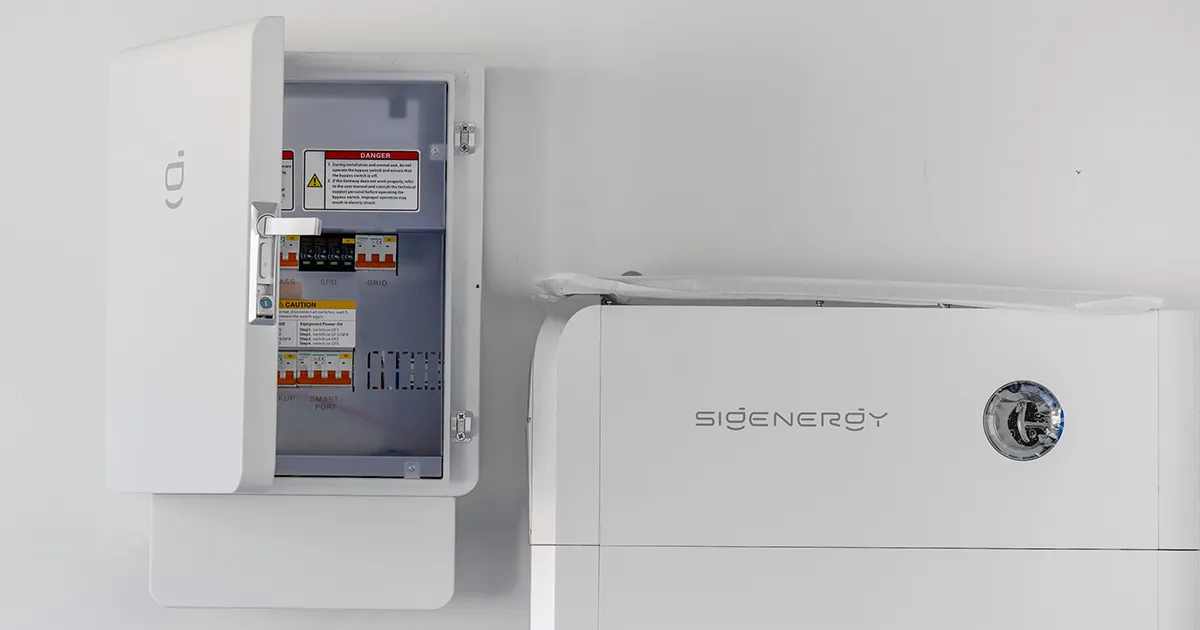
Solar batteries can be installed both indoors and outdoors in accordance with AS/NZS 5139:2019. The best location for them is the garage where it is out of direct sunlight.
Regulations
As per the Clean Energy Council regulations, all Battery Energy Storage systems needs to be installed to comply with the current versions of AS/NZS 5139:2019.
In addition, all CEC-accredited persons need to comply with the current versions of the following standards:
Indoors vs Outdoors
The first consideration of whether you should install the battery is where your live.
- Do you live near the sea?
- Do you get heavy rainfall?
- Is your climate typically quite moist?
- Do you live near a desert where the sun shines consistently?
If your answer is yes to any of the above questions, then we would recommend installing the batteries indoors if possible.
Ideally, we all want your battery and wiring to last as long as possible. Exposing them to outdoor environmental effects is only going to degrade them faster.
Sure, batteries and installation workmanship comes with years of warranty. But we should do everything we can to extend that as much as possible.
Most but not all batteries can be installed both indoors or outdoors. It is important to look at the IP rating on the datasheet, and where the manufacture recommends it to be installed.
IP Rating (Ingress Protection)
IP Rating is a rating that determines how much moisture or dust is prevented from entering devices.
The higher the first number, the less dust that can creep inside.
The higher the second number, the less water or moisture that can go inside.
Here’s a reference chart:
Typically, almost all batteries are rated to be at least IP55 so they are decently dust and water proof.
Redback Smart Hybrid has a rating of IP65

Tesla Powerwall has a rating of IP56

This means that they are suited for installation outside or inside.
Where batteries can’t be installed indoors
As per AS/NZS 5139:2019, these are the locations that a battery cannot be installed:
- as for switchboards (AS/NZS 3000)
- within 600mm of any exit
- within 600mm of any vertical side of a window, or any building ventilation, opening into a habitable room
- within 600mm of any appliance
- within 900mm below any of the above
- in ceiling spaces
- in wall cavities
- on roofs (except where specifically deemed suitable)
- under floors of habitable rooms
- under stairways
- under access walkways
- in an evacuation route or escape route.
All these are quite self-explanatory and reasonable.
Let’s take a look at what the standards say about habitable rooms.
What is a habitable room?
According to AS/NZS 5139:2019 clauses 4.2.4.2 and 5.2.4.2, these are what is considered a habitable room and a non-habitable room.
All red rooms are habitable rooms, and green rooms are non-habitable rooms.
Just to reiterate, this means that batteries cannot be installed:
- within 600mm of any vertical side of a window, or any building ventilation, opening into a habitable room
- under floors of habitable rooms

Recommended indoor location - Garage
As per the above diagram, all green locations are suitable. So here is a suggested location that would suit the guidelines and also best practices.

Where batteries can and can’t be installed outdoors
There are differences between installing batteries on a weatherboard house vs a brick house. The main consideration is that brick is non-combustible.
As a result, batteries can be located with a bit more freedom.
For weatherboard houses, you may need to install non-combustible material between the battery and the house in some circumstances.
Weatherboard house
If the battery is installed outside, it should not be installed in a location where a habitable room is on the other side.
If there is no choice, there needs to be a non-combustible material between the battery. The non-combustible material must cover 600mm on either side and 900mm above the battery.

There are no restrictions if the room on the other is a non-habitable room.

Brick house
Because brick is non-combustible, locations for the battery on the outside is far more flexible.
If the room on the other end is a habitable room, the battery can’t be placed there if there is a window or door within 600mm to the side or 900mm from the top of the battery.


Similarly, the battery can’t be located under a window if the room on the other side is a habitable room.