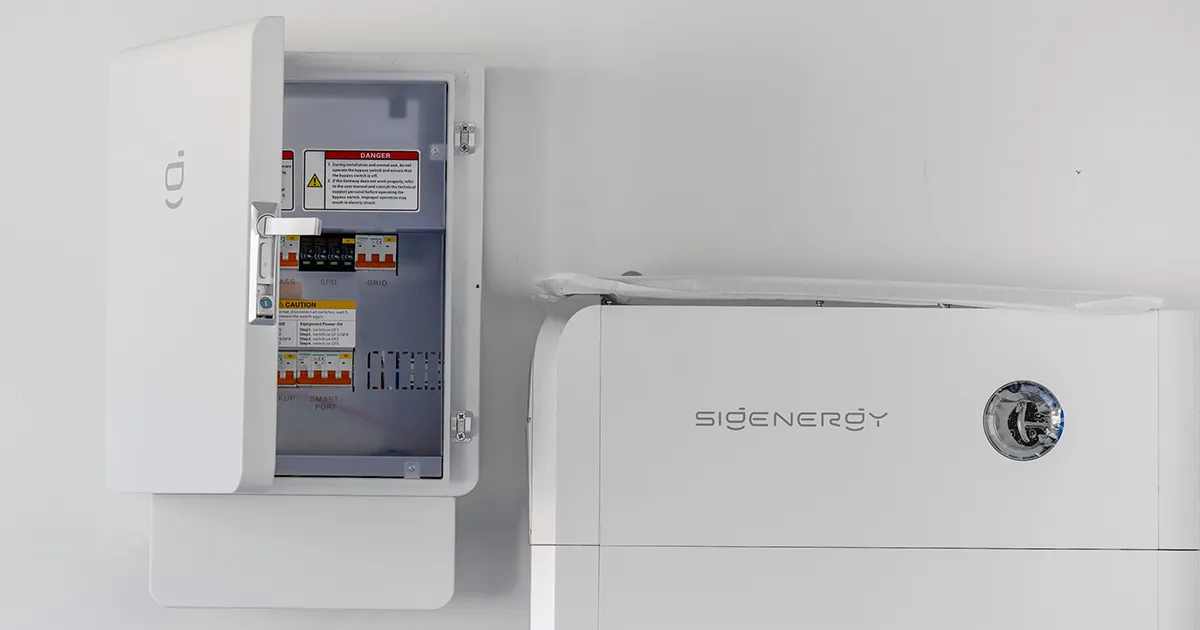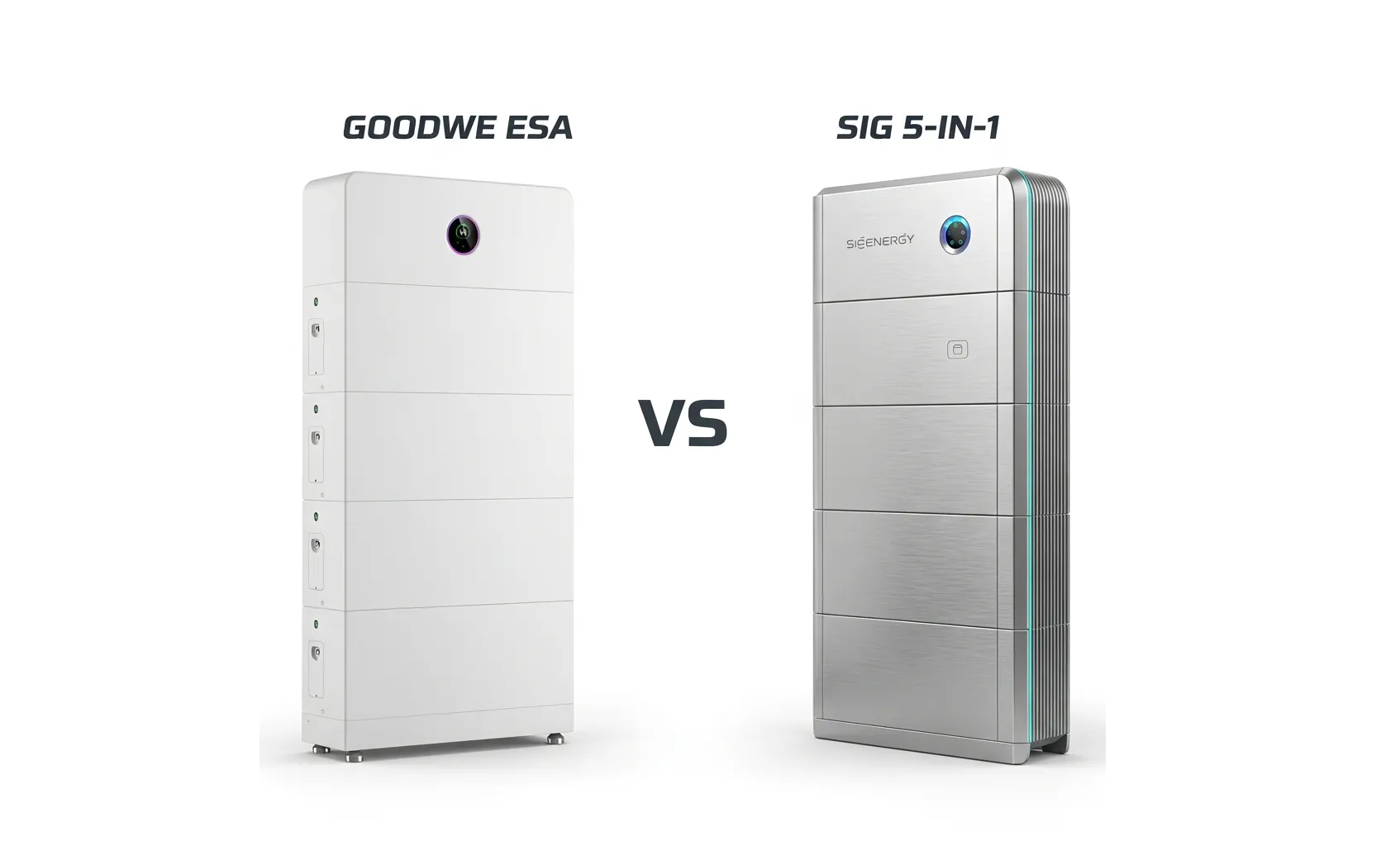
The Sigenergy SigenStor and GoodWe ESA are the two top all-in-one home battery systems in Australia. The all-in-one design means your battery comes as a single stackable tower with the inverter and monitoring system built in. To get more storage capacity, you simply add more battery modules. That design has made all-in-ones the most popular type of home battery now sold in Brisbane.
Evergreen installs both the SigenStor and ESA and we aren’t paid to prefer one over the other so what you are about to read is the straight comparison we give customers who ask us. It’s the kind of comparison you can only get from someone who has installed a few of each of these two batteries around South East Queensland.
Which is better – SigenStor or ESA?
If you have an EV or you plan on getting one, buy the SigenStor. It is the only home battery system sold in Australia that can put a DC fast charger inside the battery stack. If you don’t have an EV and don’t plan on getting one, then the ESA is the better value and the one we quote first for most homes.
Both batteries use lithium iron phosphate (LFP) cells and both are eligible for the federal battery rebate. Neither one is a bad choice but they are not interchangeable and the rest of this article explains why and how they are different.
Who makes them?
GoodWe is the older brand here. It started shipping inverters to Australia in 2012 and its batteries followed in 2020. There is a local office in Victoria which is really good to know if you ever need to make a claim on your warranty. The ESA is GoodWe’s all-in-one range and it has been available in Australia since 2025 and reviewers who usually write off value batteries have been won over by this one.
Sigenergy is three years old in this country and it has been a busy three years for them. The company was founded in 2022 and it began business in Australia in 2023, bringing us its SigenStor. The company set up its local office in Sydney and by the time the SunWiz 2026 awards were published, Sigenergy was Australia's #1 battery manufacturer overall and #1 in the residential category. Those awards were based on Clean Energy Regulator installation records rather than votes or sponsorship but Australia's installers did vote the SigenStor the best home battery in the SolarQuotes2026 Installers' Choice Awards. In the middle of all of that, though, there was also a national product recall – which we will give you some details on below.
What you get with a SigenStor
The SigenStor is what Sigenergy calls a 5-in-1. What that means is that its hybrid inverter, battery modules, energy conversion electronics, energy management system, and optional EV DC charger are all in one stack. You increase its storage capacity by adding more modules that automatically lock in place when you stack them.
The current modules hold around 8.8 kWh of usable power each with the full tower running to roughly 54 kWh.
What sets the SigenStor apart, though, is its EV module. The SigenStor was the first modular home battery system in Australia to which an EV charger could be added as a module instead of as a separate box on the wall. Also, the SigenStor’s EV module charges at up to 25kW DC while a regular home wallbox does 7kW AC. That means the SigenStor’s EV module charges your car at about three times the speed. The EV module is also bidirectional, which Sigenergy calls V2X, and which means the car can push power back into the house.
Then there is the mySigen app. It’s the best monitoring app we have used, and we have used most of them. It schedules the battery around your tariff on its own, including charging from the grid during the free 11 am to 2 pm window if you are on a Solar Sharer plan. The savings you get from that adds up to quite a bit over the course of a year.
The catch with the SigenStor, though, is the price. A SigenStor costs more than an ESA of the same size and if you opt for the EV module, then it will cost even more. Whether the extra is worth paying comes down almost entirely to the EV question.
What you get with a GoodWe ESA
The GoodWe ESA is a simpler option at a lower price. Per kilowatt-hour the ESA is among the cheapest quality batteries sold in Australia and that is one of the reasons people buy it.
The ESA is designed as a pre-wired tower – the inverter sits on top with up to six battery modules under it. The modules come in 5 kWh and 8 kWh so a stack tops out at 48 kWh. You can also mix old and new modules when you expand, which is good to know since nobody wants to find out in 2031 that their module went out of production.
Backup performance is where the ESA does well. In the event of an outage it switches over in less than four milliseconds – your lights barely flicker and computers don't reboot. The ESA also supports up to 63A, which is enough to cover more than just the fridge and a few lights.
Keep in mind, though, that appliances with motors (air conditioners, pool pumps, etc) draw a surge of current when they start and that can cause your inverter to shut down to protect itself. This is true for every system we install, no matter the brand. So you decide what needs to stay on (usually the fridge, lights and power points and not the pool pump) and we wire the backup circuits to suit that. Getting this right at the design stage is important so it doesn't become a problem later on. (Read more about how long a solar battery lasts in a blackout.)
As for monitoring software, GoodWe’s is named SEMS+. It covers the basics properly. It has live and historical monitoring, and lets you view energy flow and battery state of charge. It also lets you adjust tariff settings and schedule charging so you can tell the battery to fill during a cheap or free window and hold that charge for use in the evening.
Comparing the two apps
Where Sigenergy’s mySigen app pulls ahead of GoodWe’s SEMS+ is in the level of automation. It reads your tariff and adjusts on its own, rather than simply sticking to the schedule you had set. If you want the system continuously working the tariff for you, that is what you are paying extra for with Sigenergy. If you are okay going in to make adjustments yourself then SEMS+ is more than fine.
What was the SigenStor recall about?
Sigenergy recalled its single-phase 8, 10 and 12kW energy controllers in November 2025. The problem was with the quick-connect AC plug, which could overheat. Around 100 units were affected nationally, according to the Clean Energy Regulator. Three-phase units were not part of it. Affected customers got a firmware safeguard first, then a free replacement controller with a redesigned plug, plus an extra two years of warranty. The ACCC reference is PRA 2025/20703 if you would like to read the notice yourself.
Two things are true at once here and we think you should know both. 1. Installers filled in the Installers' Choice survey just after the recall went public and they still voted Sigenergy the best battery in the country. And, 2. SolarQuotes rates Sigenergy the most-reviewed battery brand in the country and still lists it at first among Australian battery brands but when talking about the recall, SolarQuotes does point out that it doesn’t think the company has been fully forthcoming about the issue and seems prickly with critics.
Sigenergy, for its part, put the recall down to poor installation rather than its own design. Maybe. Our own service experience with the replacements has been fine. Either way it is a reminder that who installs the battery matters as much as whose name is on it.
Which one should you buy?
Our steer: if an EV is part of your plans inside the next five years, buy the SigenStor, and have the switchboard sized for the EV module even if you don't fit it on day one. The integration is a very good advantage and, for now, nobody else sells it in one stack.
For everyone else we usually quote the ESA first. It stores the same solar as the SigenStor but for less money and there is less to configure. The main thing you give up is the app flexibility.
Sizing matters more than the brand, though. A properly sized ESA beats an undersized SigenStor and we have watched that play out more than once.
Side-by-side comparison
Frequently asked questions
Which is cheaper – ESA or SigenStor?
The GoodWe ESA is cheaper than the Sigenergy SigenStor in terms of what you pay for storage capacity. The difference narrows if you also need to buy a separate DC charger for the ESA, whereas with the SigenStor, you can start with the standard stack and add its EV module later. Keep in mind that prices change, so ask us for current numbers on both.
Are Sigenergy SigenStor and the GoodWe ESA batteries eligible for the federal battery rebate?
Both the Sigenergy SigenStor and the GoodWe ESA qualify for the federal battery rebate in Australia. The rebate amount and the 2027 step-down are covered in our Queensland rebates guide.
Can I add either the ESA or SigenStor batteries to my existing solar?
Both the GoodWe ESA and the Sigenergy SigenStor can be added to an existing solar setup, usually without replacing your current inverter. How we at Evergreen do it depends on the inverter and switchboard you already have.
Do I need the SigenStor EV module from day one?
The SigenStor EV module can be added at any point to the SigenStor stack, so it is not a day-one decision. If an EV is likely to be in your home anytime soon, though, have your installer plan the switchboard for it now.
How long do SigenStor and ESA batteries last?
Both the Sigenergy SigenStor and GoodWe ESA come with 10-year warranties. Their LFP cells, however, generally outlive this. Our guide on solar battery lifespans covers this in more detail.
What do solar panels, a battery and an EV charger cost to buy and install?
There is no single figure, because the price varies with system size, your switchboard, your roof and which battery you choose. The final total cost depends on the number of panels, battery capacity, whether the EV charger is a module in the stack or a separate wallbox, and whether your switchboard needs upgrading. The federal battery rebate then comes off the battery portion. A quote done on your actual house and needs is the only honest number, and it costs nothing to get a quote.
Who supports the home battery system after it is installed?
Support for both the SigenStor and ESA runs through us first. We install both brands and we handle the diagnosis, the warranty claim and the manufacturer conversation on your behalf – one manufacturer, one warranty pathway. Plus, both companies have Australian offices behind them.
Should I get an all-in-one home battery system or mix and match components?
All-in-one home battery systems suit most homes now. One manufacturer means one app, one warranty and one phone number when something goes wrong. Separate components will usually still win if you are working around gear you already own, or where a particular inverter or battery is the right answer for an unusual site. If you already have a good solar inverter with years left in it, keeping it and adding storage around it can be the smarter choice.
Want a price on both?
We install and service both systems across Brisbane and South East Queensland. If you want numbers for your own roof, ask for a free quote and we will size and price the two options side by side.